

Infrared thermography cameras have transformed how professionals inspect, analyze, and monitor temperature differences without touching an object. From industrial maintenance and building inspections to firefighting and medical diagnostics, these advanced devices help people see heat patterns that are invisible to the human eye.
This detailed guide explains infrared thermography cameras in simple wording, covering their working principles, applications, advantages, limitations, and future trends so readers can clearly understand this powerful technology.
1. Introduction to Infrared Thermography Cameras
Infrared thermography refers to the science of detecting heat energy emitted by objects and converting it into a visual image called a thermogram. Every object with a temperature above absolute zero releases infrared radiation, and infrared thermography cameras capture this energy to create temperature-based images.
Unlike traditional cameras that depend on visible light, these cameras operate using heat signatures. This means they can function in darkness, smoke, fog, or low-visibility environments.
The technology originally developed for military surveillance but has now expanded into commercial, industrial, and residential applications. Today, infrared thermography cameras play an essential role in preventive maintenance, energy efficiency analysis, and safety monitoring.
2. The Physics Behind Infrared Radiation
To understand how infrared thermography cameras work, it is helpful to understand infrared radiation itself.
Infrared radiation is part of the electromagnetic spectrum, located between visible light and microwave radiation. Humans cannot see infrared energy, but we feel it as heat.
Electromagnetic Spectrum Overview
| Radiation Type | Visibility | Example Use |
|---|---|---|
| Gamma Rays | Invisible | Medical treatment |
| X-rays | Invisible | Imaging scans |
| Visible Light | Visible | Human vision |
| Infrared | Invisible (heat) | Thermal imaging |
| Radio Waves | Invisible | Communication |
All objects emit infrared energy depending on their temperature. Warmer objects emit more radiation, which allows infrared thermography cameras to detect temperature differences precisely.
3. How Infrared Thermography Cameras Work
Infrared thermography cameras follow a sophisticated yet logical process to create thermal images.
First, a specialized lens collects infrared radiation from objects. This radiation reaches a thermal sensor, usually called a microbolometer detector. The detector converts heat energy into electrical signals, which are processed into temperature data.
Finally, software transforms the data into a color-coded image.
Main Components of an Infrared Thermography Camera
- Infrared lens system
- Thermal detector sensor
- Image processor
- Display screen
- Analysis software
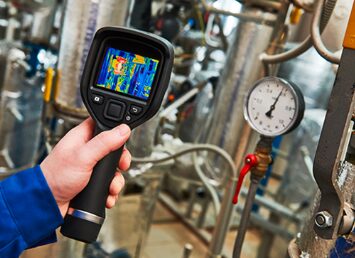
The resulting image, known as a thermogram, displays temperature variations using different colors or shades. Hot areas may appear red or white, while cooler areas appear blue or purple.
4. Types of Infrared Thermography Cameras
Infrared thermography cameras are designed for different environments and performance requirements.
Handheld Cameras
Portable and widely used for inspections, maintenance work, and building diagnostics.
Fixed Thermal Systems
Installed permanently for continuous monitoring in factories or security systems.
Drone-Mounted Thermal Cameras
Used for large-area inspections such as solar farms, pipelines, and agriculture.
Cooled vs Uncooled Cameras
| Feature | Cooled Cameras | Uncooled Cameras |
|---|---|---|
| Sensitivity | Very High | Moderate |
| Cost | Expensive | Affordable |
| Maintenance | Complex | Simple |
| Typical Use | Research & defense | Industrial & commercial |
Uncooled models are the most common infrared thermography cameras because they offer a good balance between performance and affordability.
5. Key Features and Specifications
When evaluating infrared thermography cameras, several technical specifications determine performance.
Important factors include:
- Resolution – Higher resolution produces clearer thermal images.
- Thermal Sensitivity – Ability to detect small temperature differences.
- Temperature Range – Maximum and minimum measurable temperatures.
- Field of View – Area captured in one frame.
- Frame Rate – Important for moving objects.
Radiometric cameras allow users to measure exact temperatures at each pixel, while non-radiometric cameras only provide visual heat patterns.
6. How to Use Infrared Thermography Cameras
Using infrared thermography cameras effectively requires proper preparation and understanding of environmental factors.
A typical workflow includes:
- Powering and calibrating the camera.
- Adjusting emissivity settings based on material type.
- Capturing thermal images from a safe distance.
- Analyzing temperature differences using software.
Best Practices for Accurate Results
- Avoid reflective surfaces.
- Maintain consistent distance.
- Consider ambient temperature.
- Perform regular calibration.
Many beginners assume thermal cameras measure internal temperatures, but they actually measure surface heat emissions.
7. Applications Across Industries
Infrared thermography cameras are widely used because they provide fast, non-contact temperature analysis.
Industrial Maintenance
Technicians identify overheating motors, failing bearings, and electrical faults before breakdowns occur.
Building Inspections
Thermal imaging reveals insulation gaps, water leaks, and energy loss areas.
Healthcare
Used for detecting inflammation patterns and circulation issues in research settings.
Firefighting
Firefighters locate hidden hotspots behind walls or smoke.
Security and Surveillance
Thermal cameras detect intruders regardless of lighting conditions.
Industry Applications Summary
| Industry | Purpose |
|---|---|
| Manufacturing | Predictive maintenance |
| Construction | Energy efficiency |
| Healthcare | Thermal diagnostics |
| Security | Night monitoring |
| Agriculture | Crop health monitoring |
8. Benefits of Infrared Thermography Cameras
One of the main advantages of infrared thermography cameras is their ability to inspect systems without physical contact.
Key benefits include:
- Non-destructive testing
- Real-time temperature monitoring
- Increased workplace safety
- Reduced maintenance costs
- Early fault detection
Organizations often save significant repair expenses by identifying issues before failures occur.
9. Limitations and Challenges
Despite their advantages, infrared thermography cameras have certain limitations.
Temperature readings can be affected by emissivity differences, environmental conditions, and reflective surfaces. High-performance models may also be costly, and accurate interpretation requires trained operators.
Common challenges include:
- Weather interference outdoors
- Measurement errors on shiny materials
- Need for calibration
- Operator skill requirements
Understanding these limitations ensures more reliable results.
10. Infrared Thermography vs Other Technologies
Infrared thermography cameras are often compared with night vision devices and contact thermometers.
| Technology | Detects Heat | Works in Darkness | Temperature Measurement |
|---|---|---|---|
| Thermal Camera | Yes | Yes | Yes |
| Night Vision | No | Yes | No |
| Contact Thermometer | Limited | No | Yes |
Thermal imaging provides both visualization and measurement, making it more versatile.
11. Choosing the Right Infrared Thermography Camera
Selecting the correct camera depends on usage needs and budget.
Consider the following questions:
- What temperature range is required?
- Is portability important?
- Do you need reporting software?
- Will inspections be indoor or outdoor?
Entry-level models suit homeowners and technicians, while industrial users benefit from higher resolution systems with advanced analytics.
12. Real-World Case Studies
In electrical inspections, technicians frequently use infrared thermography cameras to detect overheating connections that could lead to fires.
In building diagnostics, thermal imaging identifies hidden insulation failures, allowing homeowners to reduce energy bills.
Manufacturing plants also use thermography to predict equipment failures, preventing costly downtime.
13. Future Trends in Infrared Thermography
The future of infrared thermography cameras is strongly connected with artificial intelligence and smart automation.
Emerging trends include:
- AI-powered automatic fault detection
- Integration with IoT monitoring systems
- Smaller smartphone-compatible thermal cameras
- Higher resolution sensors at lower costs
As technology advances, thermal imaging is becoming accessible to more industries and everyday users.
14. Conclusion
Infrared thermography cameras have become essential tools across modern industries because they allow users to visualize heat patterns quickly and safely. By detecting temperature differences without contact, they help prevent equipment failures, improve energy efficiency, and enhance safety.
As innovation continues, these cameras will become more intelligent, affordable, and widely used, making thermal imaging a standard diagnostic method worldwide.
15. FAQs
1. What are infrared thermography cameras used for?
They are used for detecting heat differences in industrial inspections, building diagnostics, firefighting, security, and research applications.
2. Can thermal cameras see through walls?
No. They detect surface temperature differences, not objects behind walls.
3. Are infrared thermography cameras accurate?
Yes, when properly calibrated and used with correct emissivity settings.
4. Do thermal cameras work at night?
Yes, they do not require visible light because they detect heat energy.
5. Are infrared thermography cameras expensive?
Prices vary widely, ranging from affordable handheld models to advanced industrial systems.